
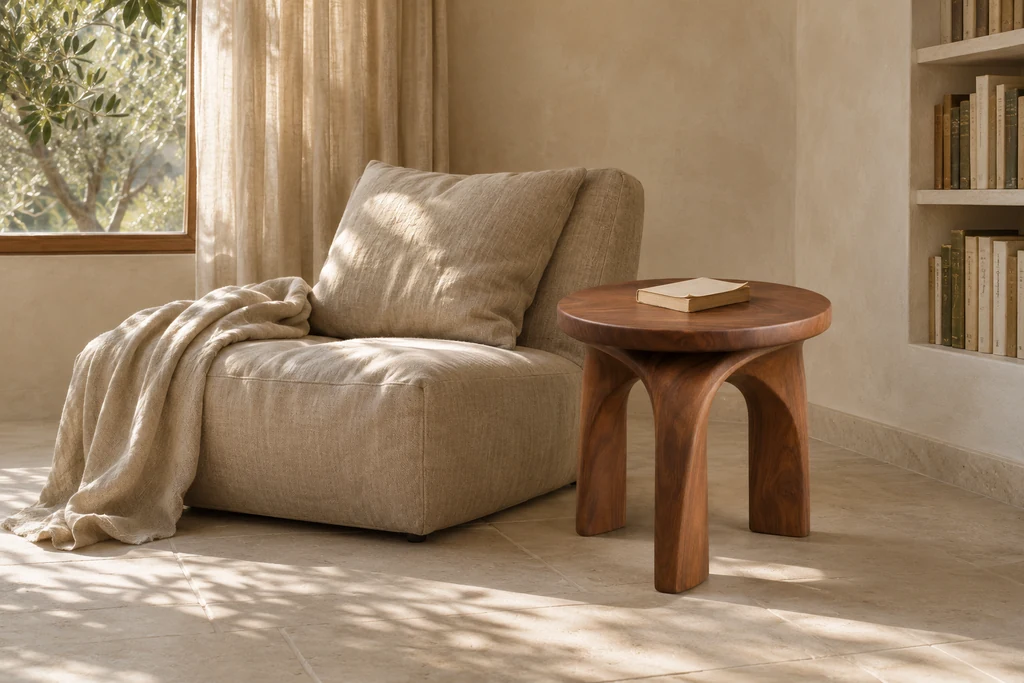
A room does not need to be finished all at once. Start with the small part of it you want to use more often: the chair by the window, the unused end of the sofa, or a quiet space beside a bookcase.
Think first about what happens there. Perhaps it is a place for ten pages before dinner, a phone call, or the first coffee of the day. The arrangement becomes clearer when it begins with an ordinary moment rather than a list of objects to buy.
A useful surface should hold what you actually reach for. Leave enough room around the chair to move comfortably. Consider the lamp from the seated position, and follow the route of its cord before deciding where it belongs. Those small practical choices are part of the composition.
Then give the corner one personal detail. A book you are reading is more interesting than a stack selected only for its covers. A familiar cup can be the right accent. Keep some space unoccupied so the arrangement can change as the day does.
This is the relationship we are studying between Vesper and Cairn. Two separate objects, useful on their own, with the possibility of becoming a small place within a larger room. Both remain concepts in development.